When Foliar Season Ends: Reading the Switch to Cut-Stump and Basal Treatments
Brewer International Technical Team
Product Development & Agronomy
Every fall, crews working forests, utility corridors, and roadside rights-of-way face the same question: how long can we keep spraying foliage, and what do we do when we can't?
The case for fall treatment is well established. As perennials shift from growth to storing carbohydrates for winter, systemic herbicides ride that downward flow into roots and rhizomes — the same principle we covered for aquatic invasive control last month. What gets discussed far less is the handoff: recognizing when the foliar window has closed and knowing what method and carrier take over.
Get that transition wrong and you spend late-season labor on applications that won't perform. Get it right and you extend productive brush work by weeks, sometimes months.
Three Signs the Foliar Window Is Closing
Leaf condition is the indicator, not the calendar. Foliar uptake depends on green, functional tissue still moving sugars downward. Three signals mark the decline:
- Color change. Once foliage shifts substantially toward fall color, photosynthesis and phloem transport are winding down. Scattered early color on stressed individuals is normal and doesn't close the window. Broad color change across the stand does.
- Hard frost with visible damage. Foliage that's wilted, blackened, or dropping after a freeze event is done as an uptake surface. This generally ends foliar season outright.
- Light frost. More ambiguous, and species-dependent. If leaves look undamaged the next morning, treatment may still be worthwhile — but expect reduced performance, and don't build a schedule around it.
During the late-season stretch when leaves are still green but toughening, penetration matters more than spread. Sun Wet, a 100% blend of methylated seed oil and emulsifiers, is built for that condition. For woody plant coverage specifically, Bark-Boost TA is a cationic tallow amine formulated for forestry, rights-of-way, and land management work. Confirm the herbicide label permits the adjuvant class and rate before mixing.
Cut-Stump: Treat It Now
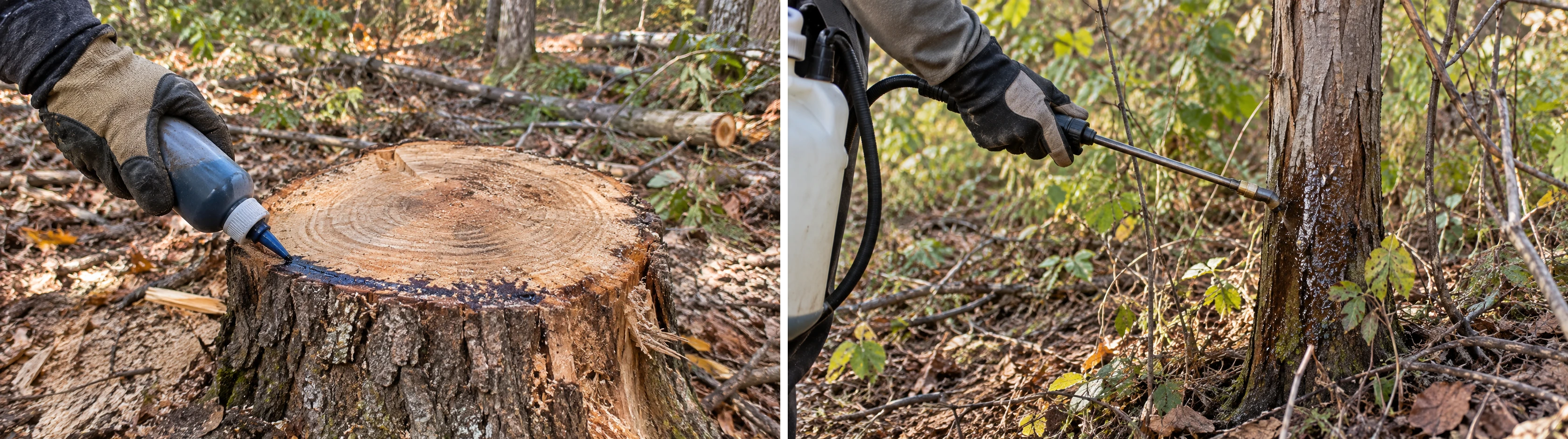
When mechanical clearing is already happening, cut-stump treatment is the natural next method — and fall is prime season because crews are on site.
- Target the cambium. The living tissue is the thin layer just inside the bark, plus the outer sapwood. Heartwood at the center is dead and won't transport anything. Treat the outer ring and the root collar, not the middle of the stump face.
- Treat immediately. A fresh cut begins sealing quickly, and on some species that window closes within minutes. The practical standard is a second crew member following the saw. If a stump has been sitting, re-cutting to expose fresh tissue beats treating over a dried surface — the extra saw time costs less than a retreatment next spring.
- Use an oil carrier. Oils penetrate cut tissue and bark far better than water and resist washoff if weather turns. Basal Bark Oil is a 100% active nonionic diluent developed for brush and herbicide control. Basal Bark Oil Improved blends basal and limonene oils for enhanced penetration with odor masking — worth considering near homes, schools, or businesses along a corridor. JLB Oil Plus and JLB Oil Plus Improved are ready-to-use basal oil diluents that eliminate diesel or kerosene as a carrier.
Basal Bark Carries Into Dormancy
Basal bark treatment continues working well past the foliar window because it doesn't depend on leaves at all. Our basal bark guide covers the technique in full — thin-barked stems, full circumference coverage of the lower 12 to 18 inches, oil-soluble herbicides like triclopyr esters, imazapyr, and aminopyralids.
The winter variable most crews underestimate is temperature's effect on the oil itself. As temperatures drop, standard basal oils thicken, and viscosity changes how a mix moves through a backpack sprayer, atomizes at the nozzle, and spreads across bark. Applications that behaved predictably in October start behaving differently in December.
Basal Bark Oil LT is a nonionic petroleum-based diluent formulated specifically for low-temperature performance. Switching carriers as the season turns cold is a small change that keeps late-season and dormant-season work consistent.
Two other conditions to watch: don't treat stems saturated with water, and don't treat when snow prevents reaching the ground line.
The Sequence in Practice
- Green foliage, no frost — foliar treatment with an MSO or penetrating adjuvant
- Early color, light frost — foliar still viable with reduced expectations; begin scheduling mechanical work
- Broad color change or hard frost — foliar closed; shift to cut-stump on active clearing sites
- Dormancy, mild temperatures — basal bark with standard oil
- Dormancy, cold — basal bark with Basal Bark Oil LT
The Bottom Line
Fall doesn't end the brush control season. It ends one method and opens two others. Crews that plan the handoff in advance — carriers staged, saw crews paired with applicators — keep working through a stretch when competitors have already parked the sprayers.
Always read and follow the herbicide label. Label directions supersede any guidance in this article.