
Skip This Fall Treatment Window and Your Invasive Weeds Win Next Season
Brewer International Technical Team
Product Development & Agronomy
As summer heat gives way to cooler nights, most applicators start winding down the spray season. For aquatic invasive plant management, though, fall is one of the most effective windows of the year to treat. Understanding the biology behind that timing — and pairing it with the right adjuvant — can make the difference between a treatment that knocks back growth for a few weeks and one that meaningfully reduces a population going into next season.
Why Fall Timing Works With Plant Biology
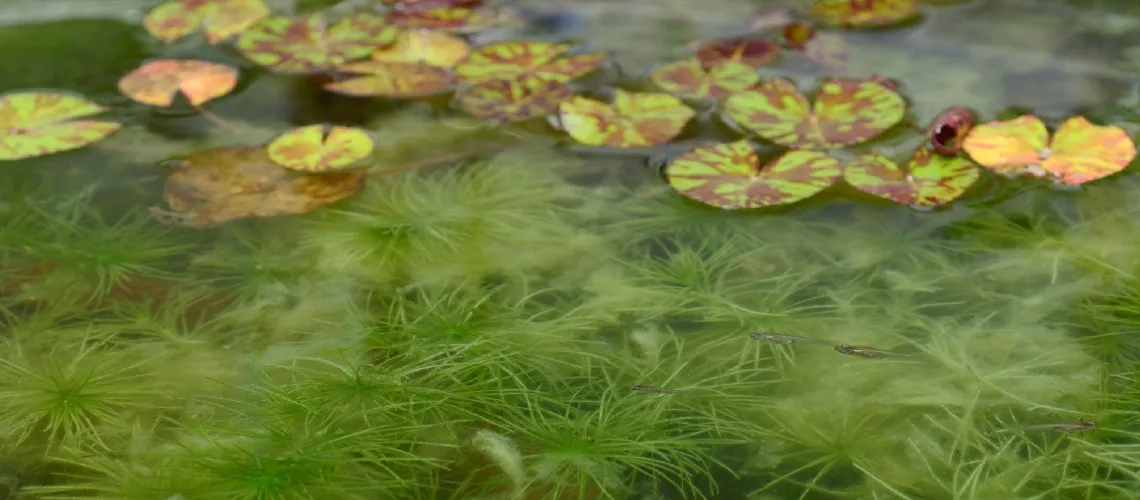
Species like hydrilla, Eurasian watermilfoil, and water hyacinth are tracked as aquatic invasive plants by the National Invasive Species Information Center for a reason: they spread aggressively and are difficult to eliminate once established, largely because they store energy in underground or submersed structures such as tubers, rhizomes, and turions.
As day length shortens and water temperatures drop, perennial aquatic weeds shift from growing leaves and stems to stockpiling carbohydrates in these storage structures for winter. That shift matters for herbicide timing because systemic herbicides move through a plant the same way sugars do — from the leaves toward storage tissue. Treating during this window carries more active ingredient down into the tubers and rhizomes where next spring's growth originates, rather than leaving it in leaf tissue that would die back on its own.
University of Florida IFAS research reflects the same principle: large-scale hydrilla control is often timed for cooler months when the invasive plant is still actively absorbing herbicide while many native species have already gone dormant. That overlap — invasive species still active, natives shutting down — is what gives fall and winter applications their selectivity edge, and it's why lower herbicide concentrations can sometimes still achieve control as water cools.
Where Adjuvants Fit Into the Equation
Timing gets the herbicide moving in the right direction inside the plant. Adjuvants determine whether it gets into the plant at all, and how well it holds up on the way there. Three categories typically do the work:
- Activator adjuvants — surfactants, wetting agents, and seed/crop oils — improve leaf penetration and uptake. This matters in fall, when cuticles are often thicker and leaf surfaces wetter than during peak summer growth. Oils can also extend contact time, giving slower-absorbing systemic herbicides more of a chance to move into the plant before dilution in the water column takes over. Brewer options: Cide-Kick II, Sun Wet, SilEnergy.
- Spray modifier adjuvants — stickers, spreaders, and invert oils — control drift and placement. Drift-control polymers keep herbicide on the target stand rather than dispersing across open water, while invert oils also help stick and limit rain wash off of herbicides from emerged and floating weeds. Brewer options: Poly Control 2, I'VOD.
- Utility modifier adjuvants — buffering and anti-foam agents — keep the tank mix workable across varying water hardness, pH, and mineral content, so the herbicide performs as labeled regardless of the water body. Brewer options: Ag-Balance+, Brewer Defoamer.
Application Considerations for Fall Treatments
A few practical points to keep in mind heading into fall:
- Favor systemic, translocated herbicides (2,4-D, glyphosate, and similar actives in aquatic-labeled formulations, depending on target species and site) over fast-acting contact products, since the strategy depends on giving the plant time to move herbicide into storage tissue.
- Match the adjuvant to the label and application method. Not every adjuvant is labeled for use over water or with every herbicide. Because adjuvant ingredients aren't subject to the same EPA registration testing as active ingredients, it's worth choosing products from manufacturers who can speak to aquatic-specific compatibility and performance.
- Avoid treating an entire water body at once. Large-scale die-off triggers decomposition, which consumes dissolved oxygen and can cause fish kills — a risk that doesn't disappear just because summer heat has passed. Sectional or phased treatment spreads the decomposition load and gives the water body time to recover.
- Take advantage of milder conditions. Cooler air, calmer winds in many regions, and lower evaporation than midsummer tend to make fall spray windows more forgiving overall.
The Bottom Line
Fall aquatic invasive plant control isn't a consolation treatment for weeds that survived summer — it's a deliberate strategy that works with how these species are built to survive winter. Choosing herbicides and adjuvants suited to that biology, rather than defaulting to a summer program, is what turns a fall application into a real dent in next year's infestation.
Have questions about which adjuvant chemistry fits your fall aquatic vegetation program? Reach out to our team — we're happy to talk through water conditions, target species, and application method.